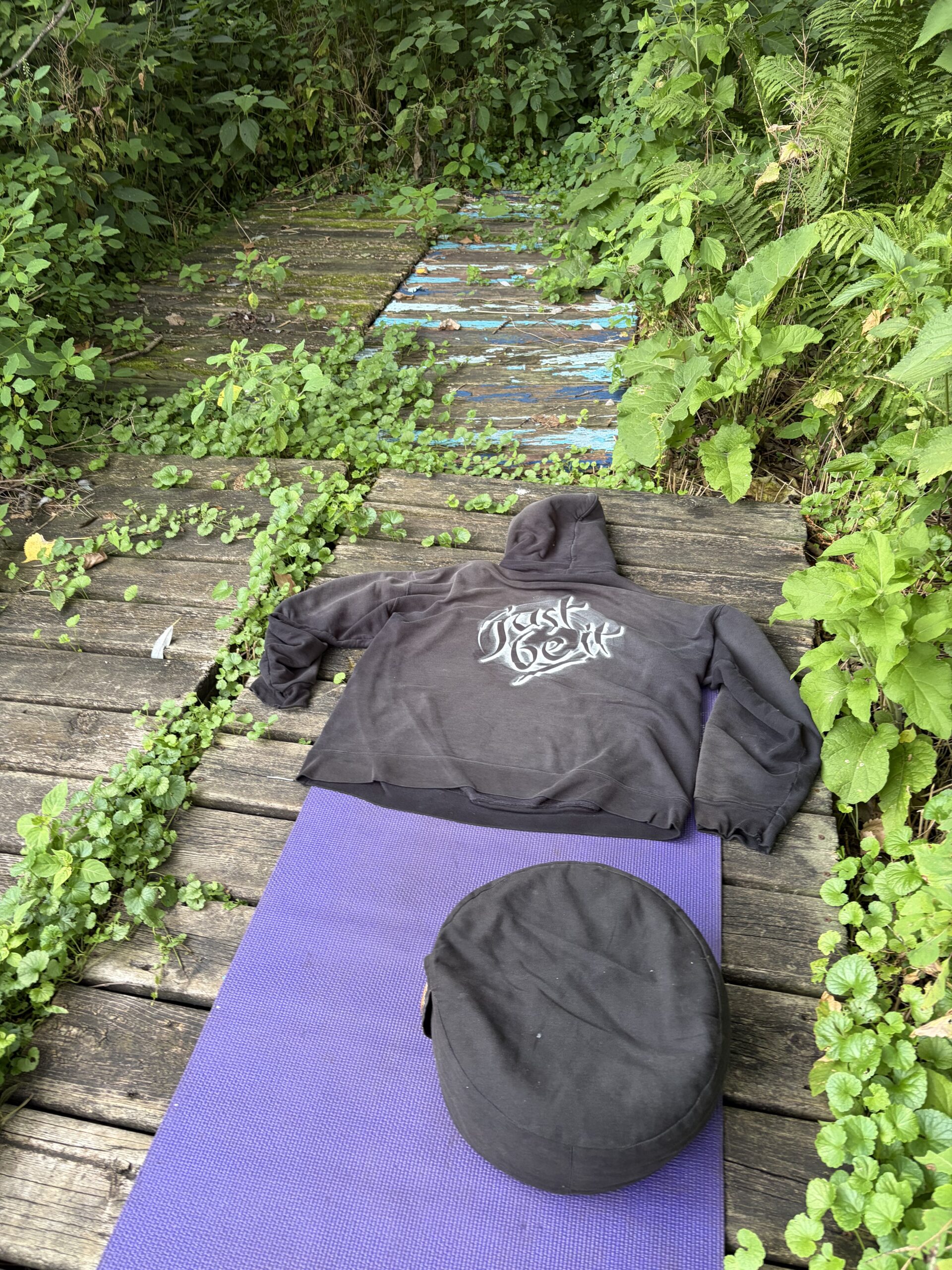
just be it Just Be It is a practice of presence that recognizes the limits of language. When aware of silence there is a state of inner still alertness. You are wholeheartedly present.

April 19, 2026

Trumpet as Awareness Practice

Filed under: Uncategorized — randy @ 7:36 pm

The trumpet has been one of my finest teachers. What may appear to others as simply an instrument of brass and valves has, for me, become a doorway to awareness, discipline, humility, and joy. Over time I came to understand that the deepest value of playing was not performance alone, but what the practice itself asked of me.

A trumpet does not respond well to confusion. It reveals tension quickly. It exposes shallow breath, poor posture, impatience, and divided attention. It asks for alignment. To produce a centered tone, the body must come upright, balance must be found, and the breath must move freely. The mind cannot be scattered in ten directions. Presence is required.

This is where trumpet becomes awareness practice.

Before the first note, there is preparation. I stand tall. I feel my feet on the earth. I notice the spine lengthen and the shoulders soften. I become aware of the breath entering and leaving. Already the practice has begun, even before sound appears.

Then comes the tone.

A sustained note teaches more than many words can teach. It asks for steadiness without rigidity. It asks for strength without strain. It asks for listening. The ear must meet the sound honestly. The body must make subtle adjustments. Awareness becomes intimate and immediate.

Long tones became meditation for me.

As the air moves through the horn, thought often quiets. Complaint softens. Regret and anticipation lose their grip. There is only this breath, this vibration, this note in this room. The trumpet rewards full attention. It does not care about yesterday’s mistakes or tomorrow’s plans. It asks only for sincerity now.

Yet there is another dimension that may be the deepest of all: the trumpet is largely a nonverbal instrument. It carries us beyond the world of explanation, argument, labels, and concepts. Words divide experience into categories. Sound reunites what thought has separated.

When fully engaged with the horn, the verbal mind often surrenders. The endless narrator grows quiet. There is no need to describe the breath, only to breathe it. No need to define the tone, only to become it. No need to explain rhythm, only to enter it.

In such moments, the boundaries we normally defend begin to soften.

Breath moves through body, body moves through instrument, instrument moves through air, air moves through listener. Where does one end and the other begin? What seemed separate reveals itself as participation in one living process. This is why music can feel sacred. It briefly restores us to wholeness.

The trumpet, tied intimately to breath, makes this especially clear. Breath is life entering and leaving. Tone is breath made audible. Awareness is breath consciously met. When these come together, one can taste a kind of unity consciousness—not as belief, but as direct experience.

Even silence becomes teacher.

The space between notes is not empty. It is alive with timing, patience, and wisdom. Many play too much, speak too much, rush too much. Music reminds us that space gives meaning to sound. Silence gives shape to tone. Rest gives value to movement. In life as in music, the pause is often as important as the action.

There is humility in the practice as well. Some mornings the tone is rich and open. Other mornings it feels stubborn. The trumpet teaches me not to cling to either experience. Show up, breathe, listen, adjust, continue. This too is awareness.

Over years of practice I found that trumpet playing improved not only my musicianship, but my way of meeting life. I became more aware of posture while walking, breath while speaking, tension while reacting, and tone while communicating. I saw that harshness in speech resembles harshness in sound. I saw that calm breath improves both conversation and music.

The horn became mirror.

When approached in this way, practice is no longer merely rehearsal for performance. Practice becomes performance of presence itself. Each tone is an opportunity to meet the moment wholeheartedly. Each phrase becomes training in balance. Each breath becomes gratitude.

The true gift of the trumpet may not be the notes we play for others. It may be the awareness it draws forth within us.

Pick up the horn.

Stand upright.

Breathe deeply.

Let thought soften.

Honor the space between notes.

And let the music teach you how to live

April 14, 2026

Just Be — Meeting Beyond the Map

Filed under: Uncategorized — randy @ 1:44 pm

I’m not you, and you’re not me. I haven’t lived your experiences, and you haven’t lived mine.

We’ve been shaped by different hands, different moments, different encounters. From this, we each build a map. And no two maps are the same.

So let’s bow— in humility—to the vastness of the territory. To the truth of what we don’t know.

From this place, it makes sense to meet with curiosity. To listen for the life behind the words. To soften our grip on conclusions, beliefs, and judgments— not because they don’t exist, but because they are always incomplete.

Often, in our insecurity, we try to change one another— hoping agreement will make us feel more solid. But real grounding doesn’t come from shared opinion. It comes from refuge. From bowing to something greater— to Grace, to the living territory beyond our maps.

What if we stopped trying to win each other over? What if we simply met— in silence first? Breath by breath. Recognizing our shared humanity. Touching what is sacred— the air, the water, the land— and committing, at the very least, to not cause harm.

When I explore what makes a life well lived, I return to a simple lens: healthy, finding refuge, and wise.

I’m curious about your health— how you care for the body entrusted to you. Not as something you own, but as something sacred.

I’m curious about where you find refuge— what allows you to rest, what brings a sense of enough, what quiets the reaching for more.

And most of all, I’m curious about your wisdom— what truly fits, what has worked over time, what you return to each day because it brings a steady sense of peace. That’s what matters. Not where your thinking has settled, but where your living has proven true.

Show me what works— what sustains you without causing harm. And in that sharing, perhaps we meet on common ground far deeper than agreement. A place where we can both rest— in humility, in curiosity, in refuge— bowing to Grace, to mystery, to this precious moment— and simply, just be

April 4, 2026

The Circle Has No Sides

Filed under: Uncategorized — randy @ 2:45 pm

When we speak from our own experience, we step onto less violent ground.

We can say,

“This is what fits me.”

“This is what works for me.”

There is no demand in that.

No pressure.

Just an offering.

But when we push another to believe what we believe, something tightens.

The space between us narrows.

And beneath that effort, there is often a subtle form of violence—the wish to shape another in our image.

To remove another’s freedom, even gently, is still to move against life.

Sharing experience invites.

Persuasion pressures.

One opens a door.

The other leans on it.

Perhaps the deeper practice is this:

to speak honestly from what we have lived,

and to trust that truth does not need force to be heard

March 13, 2026

A Sense of Wonder

Filed under: Uncategorized — randy @ 2:59 pm

In the late 1960s and early 1970s, a window opened.

For a brief moment in history, many currents began flowing in the same direction.

Hallucinogens loosened the rigid architecture of the mind.

Eastern wisdom arrived in the West carrying silence, breath, and the practice of presence.

Western mysticism reminded us that the sacred had always lived within the ordinary.

Absurdist theater exposed the limitations of language and the strange comedy of our certainty.

General semantics whispered a crucial warning: the map is not the territory.

Transpersonal psychology and transactional analysis gave us mirrors,

showing us how we move with one another—

how we react, defend, control, and sometimes, if we are fortunate, truly listen.

Out of this great convergence came a simple invitation:

Open the mind.

Walk as a pilgrim into new territory.

Be curious.

Question authority, but do not lose respect.

Hold beliefs lightly.

Remain willing to see again.

From this spirit of exploration another realization quietly emerged:

That the quality of life is deeply influenced by how we carry ourselves through the moment.

An upright posture.

A balanced breath.

A mind less reactive to the endless pull of thought.

A spirit resting in equanimity.

From here dissatisfaction begins to soften.

A practice of presence brings us closer to the simple affirmation of the moment.

And when the moment is affirmed, gratitude naturally follows.

Gratitude for the breath.

Gratitude for the rising sun and the falling day.

Gratitude for the opportunity—however brief—to participate in this great unfolding.

And perhaps this was the deepest message moving through that era:

Not rebellion for its own sake.

Not the destruction of authority.

But the quiet courage to explore consciousness,

to remain curious,

and to meet the mystery of being alive with balance, humility, and wonder

March 11, 2026

The Wake of Our Actions

Filed under: Uncategorized — randy @ 4:41 pm

When we reflect on a life well lived, perhaps the most honest place to begin is not with our accomplishments, but with the wake we have left behind.

Every life leaves a wake, much like a boat moving through water. Some wakes are gentle, barely disturbing the surface. Others churn the water, creating turbulence long after the boat has passed.

The question is not whether we leave a wake. We all do.

The question is: what kind of wake have we left?

A thoughtful life review might begin with a simple accounting: harm and non-harm.

Where have our actions brought suffering?

Where have they eased it?

Perhaps the quiet hero of our species is not the one who accumulates the most wealth, power, or recognition, but the one who moves from birth to last breath without taking another human life. Such a life may never make headlines, yet it represents a profound commitment to restraint and reverence for life.

But the examination cannot stop there.

The deeper questions begin when we consider the full impact of how we have lived—how we have consumed, what we have supported, and what we have believed.

Every meal carries a footprint.

Every purchase carries consequences.

Every belief we attach to has the potential to divide or to connect.

The collateral damage of a life is rarely limited to dramatic acts of violence. Much of it accumulates quietly through everyday habits—through indifference, through unconscious consumption, through the stories we tell ourselves about who belongs and who does not.

The divided mind is capable of justifying a great deal of harm while believing itself to be righteous.

For this reason, an honest life review asks difficult questions.

Have we taken the time to examine the impact of our living?

Have our thoughts, words, and actions been guided by reverence for the fragile miracle of life that unfolded during our brief time here?

Or have we allowed our lives to be fed by the ancient poisons of fear and greed?

A life well lived is not a life without mistakes. Such a life likely does not exist. Every human being leaves some turbulence in their wake.

The measure of a life may instead be found in our willingness to look carefully at that wake—to acknowledge where harm has occurred and to do the work, when possible, to repair it.

Across cultures and centuries, wisdom traditions have pointed in a similar direction. The Stoic reflections of Marcus Aurelius encouraged a daily examination of one’s conduct. Buddhist teachings emphasize the careful observation of intention and consequence through the principle of karma.

Both traditions recognize something simple but profound: our actions ripple outward.

A compassionate act ripples outward.

So does cruelty.

A moment of patience may soften an entire day.

A moment of anger may echo for years.

When we understand this, the question of how to live becomes clearer.

A meaningful life may be less about achievement and more about stewardship—about moving through the world in ways that reduce unnecessary harm and increase the conditions for life to flourish.

It is about cultivating awareness of the wake we leave behind us.

And perhaps, with enough humility and attention, we may learn to move through the waters of life more gently—leaving behind a wake that carries less turbulence and more care for those who come after us. ?

March 10, 2026

Conscious Deprivation

Filed under: Uncategorized — randy @ 12:05 pm

Consciously dealing with deprivation helps us deal with the number one cause of suffering, our dissatisfaction caused from our attachments. Where I was trying to push things away or crave different circumstance. Until we can land in satisfaction for what is, we can’t sustain a sense of satisfaction.

When we can let go and experience what it is like without, we’re letting go our craving to have things comfortable. With a courage to move into that space of uncomfortability we can explore the support and Grace given to “just be“. 

Someday I imagine a politics and religions based on gratitude, peace, moderation, and a deep desire to understand through listening. Today, we are being led by those with an insatiable appetite for more and more. They have not found the value of conscious deprivation. They don’t know what it’s like to be deprived of food or shelter. When they have never had this experience of deprivation, they have less capacity for empathy to the vulnerable. Their sense of collateral damage from actions taken simply doesn’t seem to be there. They failed to realize that the more they grasp what they think they own or the more they crave more power and wealth, the more they suffer. These are the poisons of fear and greed. The failure to break through the illusion of separateness causes an inability to see not only they’re suffering, but the suffering of others as their own.

Wisdom must always be tested.

Filed under: Uncategorized — randy @ 11:55 am

When we advocate for peace and non-violence, we must honestly ask:

Do our actions work?

Not according to ideology,

not according to pride,

but according to the simple law of efficacy.

Did the Vietnam War work?

Did the preemptive invasion of Iraq work?

Did the seizure of a foreign leader bring wisdom into the world?

When we look carefully,

when we remove the slogans,

we must admit that violence rarely produces the peace it promises.

Perhaps the most important question we can ask our elected leaders is simple:

What is your wisdom?

And what do you mean by wisdom?

Is your wisdom locked inside rigid beliefs and inherited narratives?

Or is wisdom something living—

a practice continually tested

by the law of efficiency, compassion, and non-harm?

Today I lift my horn.

I have been asked to play taps to honor the fighting of soldiers who supposedly brought us freedom.

But when I look honestly at the wisdom of the wars they were asked to fight,

I cannot blow my horn in honor of violence.

Today I play my horn for something else.

For healing.

For the reduction of suffering.

For the day when wisdom replaces our habit of war

March 9, 2026

We treat things with greater reverence

Filed under: Uncategorized — randy @ 5:34 pm

when we accept the truth

that everything fades.

We appreciate our mobility

when we understand

that one day we will lose it.

We appreciate sight,

sound,

touch,

and smell

when we accept that they too

will one day dissolve.

This recognition is not depressing.

It is the doorway to gratitude.

Life becomes more joyful

when we participate in it

with appreciation

rather than complaint

about the inevitable changes.

Yet we often create stories

to make ourselves feel grounded.

Stories that try to deny impermanence.

Stories that try to wash away the harm we have caused

with declarations of total forgiveness.

But the wisdom of Karma offers a different invitation.

Not denial.

Not erasure.

Instead it invites us to burn away the harm we have created

through good action.

Through compassion.

Through stewardship.

Through repair where repair is possible.

Living this way becomes easier

when we accept that we too are part of Entropy.

We fade.

Just as all things fade.

Life is not simple.

It is filled with voices urging consumption,

dissatisfaction,

complaint,

judgment,

and narrow thinking that tries to soothe the restlessness within us.

But those are only temporary salves.

True healing begins

when we recognize two truths at once:

that all things are dissolving

and that all things are connected.

When we accept both,

gratitude arises naturally.

And from gratitude

comes the desire to care for this brief participation in life

with tenderness

March 5, 2026

Everything fades.

Filed under: Uncategorized — randy @ 11:08 am

Mountains soften.

Rivers change their course.

Cities rise

and quietly fall.

Pause.

Even our names

will someday disappear

into the wide silence of time.

Pause.

So what is the rush?

Why the grasping hands?

Why the hardened opinions?

Why the endless hurry

through a world

that is already passing?

Pause.

Another breath in.

And out.

Pause.

If everything fades,

perhaps the invitation is simple.

Meet this moment

with stewardship.

Care for the soil.

Care for the waters.

Care for each other.

Pause.

Meet this moment

with compassion.

Not because things will last forever—

but because they will not.

Pause.

We cannot stop the fading.

But we can soften it.

We can let the world

fade more gently.

Pause.

One more breath.

In.

And out.

And simply rest

in this moment

that is here

for a little while

March 4, 2026

Beyond Words

Filed under: Uncategorized — randy @ 12:54 pm

Quality of life improves

when we move toward the nonverbal —

no thought,

no opinion,

no judgment,

no complaint.

It improves when we step outside.

Buildings are made of walls.

Words are made of conclusions.

Both can quietly enclose us.

Real nourishment comes

when we increase our time in open air —

away from verbal constructions,

away from the city’s constant narration.

Listen:

Birdsong.

Moving water.

Wind through leaves.

See:

Blue.

Green.

White clouds drifting.

Witness:

Blossoming flowers.

Children laughing.

Breath entering clean and unhurried.

Outside,

the mind softens.

The body remembers.

No commentary required

Older Posts »

Powered by WordPress